


Launceston
Community Market
SENDING Love to Ukraine (SLTU) started as a plan of Darren Tait’s (based in Callington) to take a van load of aid to Ukraine in the first days of the Russian invasion.
As the hours passed, the number of vans increased, and in the early hours of Sunday, March 6, 2022, nine vans set off in the first convoy. This was down to a large group of volunteers, and the group has grown, with people donating, sorting and loading. This effort has been supported by local businesses, organisations and charities who have given generous financial support plus the loan of storage space. They work closely with contacts on the Poland/Ukraine border who tell them what is needed, and they try to deliver. They have sent 250 van-loads of aid, including three ambulances. This means that on average, generous supporters have filled a van with aid every five days since Russia invaded.
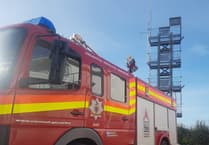

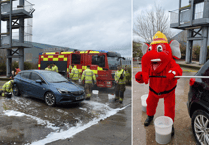

They are into year-four of their efforts, and are preparing for Trip #38 that will leave on February 14. They are so grateful to everyone who has joined this worthy cause and ask that we all continue to support us in any way that we can.
The Launceston Community Market meets every Friday morning at Methodist Central and all the money raised goes to local charities and good causes. They are very happy to have raised £200 to help Send Love To Ukraine and always welcome suggestions for the next good cause.
Stamp club
THE meeting opened on a sad note with the chairman giving the news that founding member Vera Ellacott had passed away and asking members to stand for a minute’s silence in memory of Vera.
Barry then introduced the speaker for the afternoon Mr Bob Wheeler. This was Bob’s third visit to the club. Bob explained that this display had not been seen for 20 years.
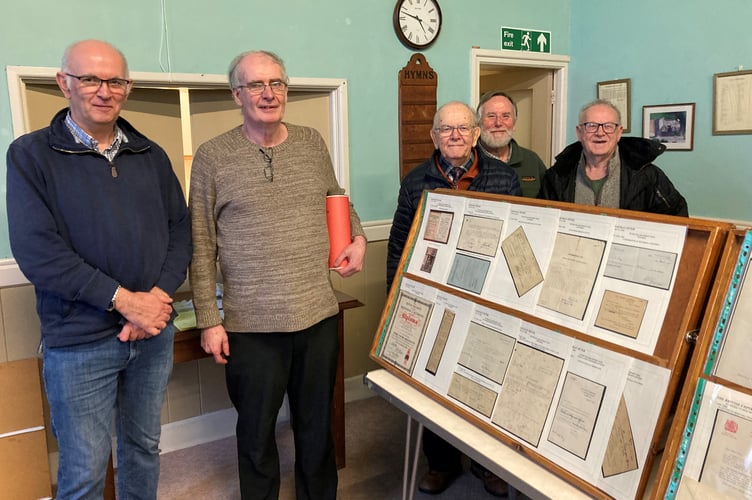
The first part comprised a wide array of designs, essays both adopted and unadopted, trials and proofs. There were examples of watercolours, pencil drawings and the use of photography with several well known artists represented including David Gentleman and Pat Oxenham. An early example of a self adhesive trial by De la Rue as well as canceller trials were shown. Next came a selection of licences for various purposes. Those featured included a Gamekeepers Licence, a Licence to Kill Game, Licences to Sell Beer and Wines, Licence for a Bus Coductor, a Post House Revenue Ticket and examples of tax collected on playing cards and theatre programs all means by which the government of the day extracted money from various everyday activities. There was an example of paperwork to enable pensioners in 1953 to get relief on the purchase of tobacco.
A most interesting set of documentation was shown following the career of a postman who started as a telegram messenger on a bike – then a motorbike – and eventually becoming a postman with a van and finally a telegraphs officer.
To finish off Bob showed a paper trail of a lady who had completed 50 years service with the National Savings Bank and was awarded the British Empire Medal. There were congratulatory letters from the Queen and various officials, a copy of the Post Office Magazine and finally the medal! A truly remarkable display and a vote of thanks was given by the chairman who presented Bob with the club’s certificate of appreciation.
Launceston Stamp Club holds its annual ‘Stamp and Postcard Fair’ on February 28 at the Lifton Community Centre from 9.30am to 3.30pm. Admission is free.
Launceston Stamp Club meets on the first Thursday of each month at the Yeolmbridge Methodist Chapel Hall Ladycross at 7.30pm (May to October) and 2.30pm (November to April). Visitors and prospective members always welcome. Next meeting on March 5 will be an auction.
Bude and District
U3A
Bude and District U3A open monthly meeting was held at the Parkhouse Centre, Bude on January 15.
The chairman, Jim Buck, welcomed everyone and made a few general announcements. Nick Faulks, deputy chairman, then introduced the visiting speaker for the afternoon, Karl Ritz, whose talk was entitled “Plant Roots - the hidden half”.
Karl is a retired professor of soil ecology. The subject was related specifically to plant and tree roots, which is a follow on from previous talk which focussed on microbiology of the soil. He explained that plant and tree roots are very complex and tangled and can vary in length from one to five centimetres deep.
He stated that there are three types of roots which are primarily categorised into taproot systems (one thick, main vertical root, e.g. carrots) and fibrous root systems (a dense, shallow network of similarly sized roots, e.g. grass). A third type, adventitious roots, grows from non-root tissue like stems or leaves, often providing extra support.
Karl explained that the roots main priorities are to anchor the plant in the soil, absorb essential water and dissolved minerals, store food reserves, and conduct these resources up to the stem, while also facilitating gas exchange and sometimes supporting vegetative propagation, all crucial for plant growth and survival.
Anatomy: Karl explained that there are a vast range of patterns in plant roots, they are complex, specialised organs designed for anchorage, water/nutrient absorption, and storage, comprising a protected tip, zones of growth, and specialised tissues that differentiate between monocot and dicot structures.
Karl then talked about how adaptable plants can be. He explained that plant adaptation is when a species develops special features to improve its chances of survival. Adaptations evolve over a long period of time, and they are inheritable, meaning they are passed on to offspring. Root adaptations are specialised structural and physiological modifications enabling plants to survive diverse environments by enhancing anchorage, water/nutrient uptake, and gas exchange.
Soil compaction restricts root growth by increasing mechanical resistance and decreasing pore space, causing roots to become shorter, thicker, and less branched. Roots detect this stress through increased ethylene accumulation. Common adaptations include radial expansion (swelling), lateral root proliferation, and searching for, or creating, fissures to penetrate deeper soil layers
Karl then explained about root symbiosis. A mycorrhizal network (also known as a common mycorrhizal network or CMN) which is an underground network found in forests and other plant communities, created by the hyphae of mycorrhizal fungi joining with plant roots. This network connects individual plants together. Mycorrhizal relationships are most commonly mutualistic, with both partners benefiting, but can be commensal or parasitic, and a single partnership may change between any of the three types of symbiosis at different times. The formation and nature of these networks is context-dependent, and can be influenced by factors such as soil fertility, Some plant species, such as buckhorn plantain, a common lawn and agricultural weed, benefit from mycorrhizal relationship ‘Nitrogen Fixation’. Nitrogen + Ammonia = Fertiliser. Roots hairs develop and as a result evolution took place beneficial microorganisms that form a symbiotic, mutually beneficial relationship with plant roots, acting as an extension of the root system to drastically increase nutrient (especially phosphorus) and water uptake.
Karl concluded his talk by asking if anyone had any questions or would like any more information. There were a few questions put to Karl which he duly answered. The afternoon concluded with the usual tea and biscuits. In between monthly meetings Bude U3A members enjoy pursuing a wide variety of interests.
If anyone would like to find out more they will be very welcome to drop in on a coffee mornings held on the first Friday of the month at The Weir, or the third Friday of the month at the Falcon Hotel from 10.30am, or visit the website at www.budeu3a.co.uk
Chilsworthy
Methodist Church
‘To the Sahara and beyond’ — Mark Shepherd, retired Penbode Vet, spoke to an invited group of sixty men on Tuesday evening, February 3, in Chilsworthy Methodist Church.
Mark entertained the men with slide photos of his trans-Saharan trip in a vintage Land Rover over forty years ago. Snakes, crocodiles and sand-dunes; hippos, black market racketeers and appearances on African TV kept everyone awake, as well as accounts of the care of their old Series One. Pasties and tea were served by other members of the CVM team. This evening was part of the regular programme of CVM (Christian Vision for Men) events in North Devon.
Village hall
The monthly Village Coffee Morning for February in the Social Club at the Village Hall was held on Thursday 5th. Thank you to Joan Sussex and Lesley Coxon for acting as hosts this month.
Methodist Chapel
Paul Wreyford of Bude led the service at the Methodist Chapel on Sunday, February 8. Karen Shepherd gave the welcome and highlighted the notices.
The singing was led by Sandra Shepherd and Christine Tratt on keyboards, Mark Shepherd on guitar and with Pamela Newton and John Cleave as vocalists.
The lessons were read by Mary Care and the prayers were led by Maxine Whenmouth.
Refreshments were served after the service.
Comments
We've recently changed our login process. If you have an account for commenting, you will need to re-register on the login window.
This article has no comments yet. Be the first to leave a comment.