
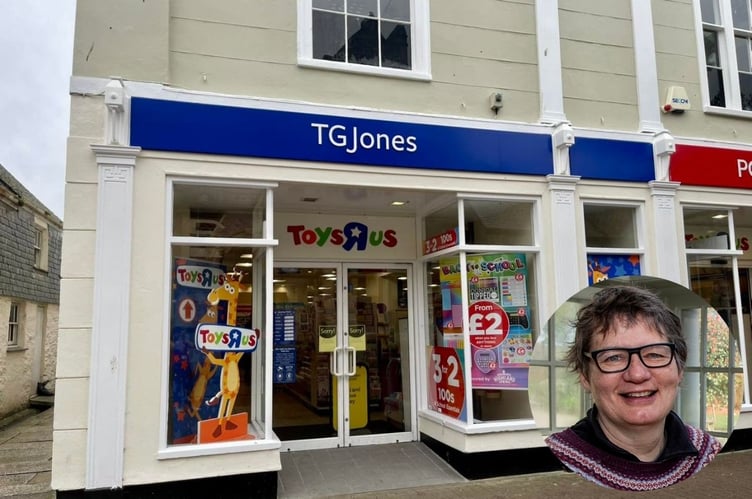
IF you’d asked me in my teens what my favourite high street shop was, I’d have said WH Smith in a heartbeat. It wasn’t cool, but then neither was I.
As the principal retailer of nice stationery, a comprehensive array of books, magazines, newspapers and chart music, Smith’s had everything I needed and loved. A few decades on, it’s still one of my go-tos.
In its current guise of TG Jones, it’s still the only place in the city centre that sells a wide range of specialist publications, as well as a reliable stock of magazine storage, flip-top reporter’s notebooks and functioning biros.
But I’d be lying if I denied that it had lost its shine somewhat – and it’s nothing to do with the name change, ridiculous as that move may seem.
WH Smith’s 480 high street stores were rebranded TG Jones after being taken over by Modella Capital in June 2025; but the historic name itself wasn’t for sale, retained by the vendor for its separate chain of travel stores found in railway stations, airports, motorway services and even hospitals.
While William Henry Smith was a real person, who renamed the family company after himself upon taking the helm in 1828, TG Jones is a fiction invented to sound roughly like its predecessor. Business as usual, nothing to see here, move along now.
Of course, no one was fooled. I’m sure I’m not the only UK shopper to persist in calling it “Smith’s”; I usually correct myself, but I’m sure many don’t, on the stubbornest of principles.
In May this year, Modella Capital blamed its financial difficulties on this name change, claiming it had “negatively impacted consumer awareness”. This was surely the lamest of excuses.
After all, the shops are in exactly the same places they’ve been for decades, selling exactly the same things as before. Does Modella Capital really think customers will be confused by the change above the door? Same font, same colours – how many people even look up before entering the shop?
The truth is, the way people shop has changed, and everyone knows it. That’s arguably why WH Smith put its high-street outlets up for sale in the first place.



The smorgasbord that drew me in as a teenager has dwindled to a buffet of curly sandwiches. The music offer is tokenistic; the magazine range, albeit still the best in town, has shrunk and has been shoved to the darkest depths of the store. Photo albums cost £25 each, and large chunks of space are filled with franchises like Toys R Us.
We stream 70 per cent of our music rather than buying CDs. The printed photo has died a death in the face of social media. Home printers, which used to sell their cartridges here, now favour “smart” subscriptions that mail ink out when you need it.
Meanwhile, other retailers have broadened their scope. Supermarkets sell the most popular newspapers, magazines and books, while Waterstones is the big daddy for the written word in Truro (no independent booksellers here).
The Post Office that takes up the windowless bowels of the Truro store is to be evicted four days before TG Jones closes its door for good. Customers and politicians are working at pace to find alternative city-centre premises that will offer a full range of services in easy reach; the current options - Trelander, on a tight residential estate with limited parking, and Shortlanesend, a full bus journey away – are less convenient and offer a limited range excluding Passport Check & Send, vehicle tax, a range of travel money and on-demand travel insurance.
This is indisputably frustrating, especially for those who value face-to-face contact. But the Post Office has been forced to abandon its own premises due to a toxic combination of digital communications and fierce competition taking chunks out of its profits.
A book of stamps can be picked up at any local supermarket, while money can be changed at M&S. And how many of us have received good via Evri or InPost, possibly from a petrol station locker?
We have allowed all this to happen. We’re quite happy to shop in a way that offers maximum convenience, yet we emit howls of rage when stores close and leave gaping holes in our town centres, ostensibly killing them off slowly. We are our own worst enemies.
And yet. In September 2023, Wilko closed in Truro’s Boscawen Street. Then, as now in TG Jones, business was brisk in pursuit of a closing-down bargain. It seemed as if Truro’s heart would be blighted by a cavernous absence – until Mountain Warehouse moved in, the chain’s largest UK premises and still going strong today.
The message is clear. The high street is not yet dead – but if we value the physical attractiveness and social interaction it offers, we need to vote with our feet and support it.
Comments
We've recently changed our login process. If you have an account for commenting, you will need to re-register on the login window.
This article has no comments yet. Be the first to leave a comment.