
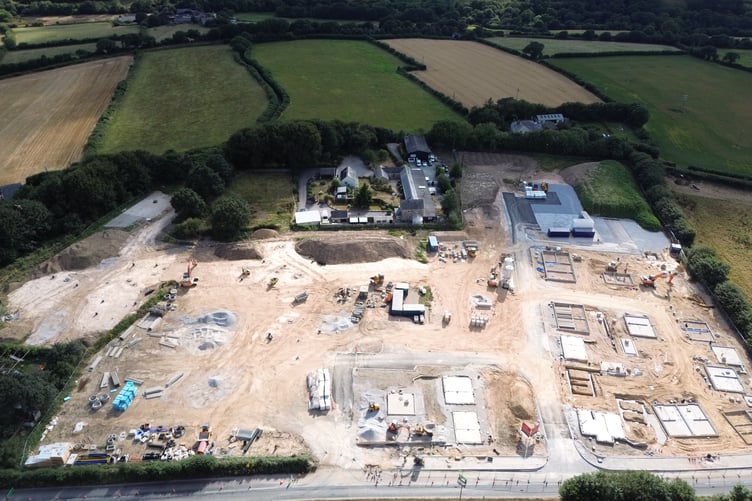
A DEVELOPER which is presently constructing 58 houses on land near Pandarosa Barns in Bodmin has told Cornwall Council its planning obligations to pay £348,798 makes the scheme unviable.
Wainhomes South West secured planning permission to build the fully open-market development on the land, located opposite Bodmin Hospital in March 2026.
Typically, developments are required to pay financial contributions towards the provision of infrastructure in a town – with set levies for each open market dwelling constructed.
In Cornwall, this includes £2,736 for each dwelling towards education infrastructure, and £385 for health facilities. Affordable or social dwellings are excluded from the requirement for contributions.
The Section 106 agreement between Cornwall Council and Wainhomes in March 2026 stated that the developer would be required to pay £158,053 for the provision of education facilities, £22,520 for health care facilities, £161,749 for the provision of transport facilities and a planning administration fee of £4,476.
It also agreed the on-site provision of public open space and the transfer of ‘serviced land’ to Cornwall Council.
The ‘serviced land’ refers to the land put aside for a primary school. As part of the development, there would be allocated land set aside for a new primary school with a clause in place in the deal between the developer and Cornwall Council that stipulated that the school must be built within ten years or the land could be acquired back by the developer.
It later transpired Cornwall Council had no present plans to build a school in the town, leaving open the possibility that in a decade’s time, Wainhomes South West would be able to build more houses on the land.
The developer’s request for no affordable housing in the scheme was accepted by Cornwall Council’s planning department on the basis that the developer would be making a loss on the land which it purchased at the market rate for the primary school being sold to Cornwall Council for £1.

However, just weeks after planning was granted and construction beginning in earnest on the site, the developer is now seeking to reduce or remove the near £350,000 payments it must make towards town infrastructure and facilities.
It has submitted a report by consultants Vickery Holman that states that the scheme as-is with the financial obligations would mean that the developer would not achieve a sufficient profit to make the scheme viable.
In an analysis that assumes a developer profit of 17.5 per cent per property, the consultant’s report said that when the costs of construction, property prices and land were factored in, its analysis meant that the scheme was ‘unviable’ in planning terms.
The report stated that if the developer’s obligations for the £348,748 payments were removed, it would improve the situation.
Its conclusions detailed why it views the scheme as unviable, using industry standard benchmarks known as Residual Land Value (RLV) and Benchmark Land Value (BLV).
A residual land value is the money left over for buying the land – and is calculated by taking the expected sale value of the finished project, known as a Gross Development Value (GDV), subtracting all building costs, fees, taxes and developer profit.
A benchmark land value refers to the minimum price needed to convince the owner to sell the land and is calculated as the current use value of the site plus a small extra bonus or incentive for the owner.
It is these calculations which are used by developers to assess whether a development is considered viable or unviable.
A viable project is one where the residual land value is equal to or higher than the benchmark land value, which means that the project can go ahead and afford the contributions required such as affordable housing or towards infrastructure.
An unviable project is one where the residual land value is lower than the benchmark land value meaning that the project potentially loses money and leads to the developer asking to reduce community costs or its required proportion of affordable housing.
In the conclusions to its report to Cornwall Council, Vickery Holman stated why in its view the scheme was considered unviable.
It said that if the obligations were maintained at their full level, it would generate a residual land value of minus £65,000, representing a deficit of £1,015,000 when compared against the benchmark land value of £950,000.
However, if the benchmark land value is assumed as the land purchase price, the appraisal generates a developer’s profit of £2,052,791, equivalent to 10.90 per cent of gross development value, which Vickery Holman states is below the level typically required to support a development of this nature.
It says as the residual land value falls significantly short of the benchmark land value it is unviable in planning viability terms.
However, it compared that analysis to one which involved the total removal of the £348,798 contributions.
It said that their appraisal generated a residual land value of £280,000, representing a deficit of £670,000 when compared to the benchmark land value of £950,000.
However, if the benchmark land value is assumed as the land purchase price, the appraisal generates a developer’s profit of £2,473,457 which is equivalent to 13.13 per cent of gross development value, which remains below the level typically required to support development of the type at Pandarosa.
The analysis added that while the removal of the planning obligations would still see the residual land value continue to fall short of the benchmark land value, the removal of the Section 106 obligations ‘does materially improve the financial viability of the development and reduce the deficit against the benchmark land value’.
Find out about planning applications that affect you by visiting the Public Notice Portal.
The application can be viewed using reference PA26/04559.
Comments
This article has no comments yet. Be the first to leave a comment.