
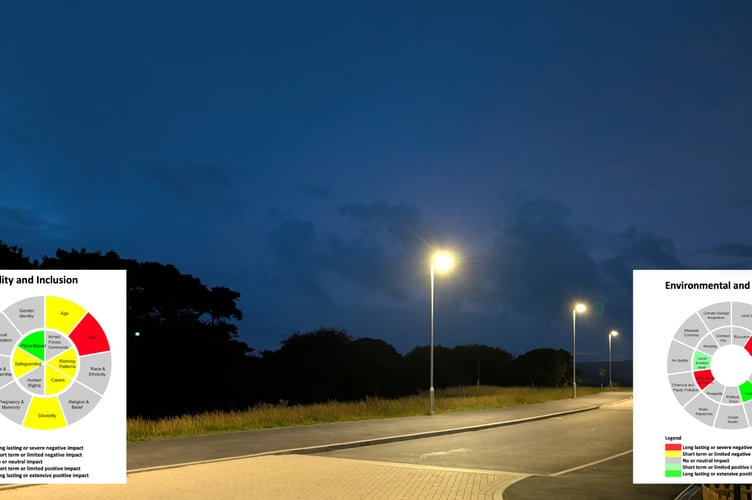
A Freedom of Information request by Tindle Newspapers seeking the documents used to justify the arguments being made that the turning off or dimming of street lights would represent an improvement have revealed that the council’s own assessments indicate that it represents a ‘long lasting or severe negative impact’ to people’s safety.
Cornwall Council, as part of its decision making uses a system called a ‘decision wheel’, where officers have to identify the potential positives and negatives of a proposed project, in this case the ‘LED Streetlight Replacement Project’, which incorporates its scheme to reduce the hours highway lighting is operational.
This system has identified the risks and benefits the council believes the changes will have.


Concern over women’s safety
The document states: “This initiative could be perceived as a safety risk due to lights not being in operation. Policy will allow for lighting to remain on but ultra-dimmed in areas deemed as 'high risk' i.e. in town centres, conflict areas, those with high pedestrian footfall. Ultra-dimming can be done on a scale from 99 per cent light out down to one per cent, and this is most likely to be around 30 to 40 per cent initially.
“Lighting in areas with highway and public realm CCTV would remain on all night but ultra-dimmed (to the point of still allowing CCTV operation) upon completion of the LED project. Concern has been raised by Safer Towns groups regarding the safety of women and girls if lighting is switched off.
“As a direct result of this consultation, we will now leave lighting on until 3am on Saturday and Sunday mornings in towns and cities where night-time economy is more prominent. We are working closely with the police using their crime data to ensure we do not add inherent risk to known crime areas where it is deemed switching lights off will cause further crime.”
.png?trim=0,0,0,0&width=752&height=913&crop=752:913)
The other risk identified by the document stated that the turning off of the streetlights during the hours proposed may lead to more people fearing going out during the night.
It said: “Some members of at-risk groups may fear going out without streetlights illuminated, however as the operation is proposed to be midnight to 05:00, the realisation of the expected impact remains low. this time has been chosen when the majority of people are asleep. Based on the Census 2021 data for Cornwall, at-risk groups may include the following - Disability (21.1 per cent), Bad or very bad health (6.2 per cent).”
However, the council assessed that it could represent both positives and negatives so far as people’s health is concerned, stating: “Residents that live in an area with streetlighting would benefit from a reduction in light pollution across all areas of Cornwall. However, with the cost-of-living crisis, some residents may have to walk to work when street lighting has been turned off, this could raise anxiety levels which could result in the deterioration of a person’s mental health.
“The lighting being kept on in town centres will offer significant mitigation to this risk, along with the fact the lighting will only be switched off from midnight to 5am. However reduced lighting during the middle of the night may also help some people sleep better.”
Boost for Bats
However, it has been identified that the main beneficiaries of the scheme are biodiversity and greenhouse emissions.
The council’s analysis states: “This initiative could affect the whole of Cornwall. The ability to reduce lighting during particular hours could increase benefits further for nocturnal animals etc as there would be longer periods of darkness, particularly in rural areas. Darkness is crucial for our nocturnal wildlife, such as bats, moths and hedgehogs. We may not always see these night-time creatures, but they play an important role by eating slugs and snails and pollinating crops and wildflowers.
“Sadly, light pollution caused by humans means it is less dark at night. Street lights and other light sources make it lighter during the night, not only for us but for wildlife too. This changes the amount of space wildlife has to find food, a mate and lay eggs and ultimately impacts on their numbers.
“Cornwall Council’s new approach to dimming street lights, turning certain lights off for some of the night and using lights which shine over a smaller area, will create more darkness for our night-time wildlife.
“We can all get involved and do our bit to keep the night dark for nocturnal wildlife: closing our curtains when it’s dark and turning off outside lights are simple actions with big impacts. Together, we can reduce light pollution and support recovery of our important nocturnal wildlife.
“This initiative could reduce CO2 from energy reduction through providing reduced hours of street lighting (switch-off between midnight and 5am). The burning hours would reduce by 1,794 equating to £0.5-million with the current energy prices.”
‘Severe negative impact’
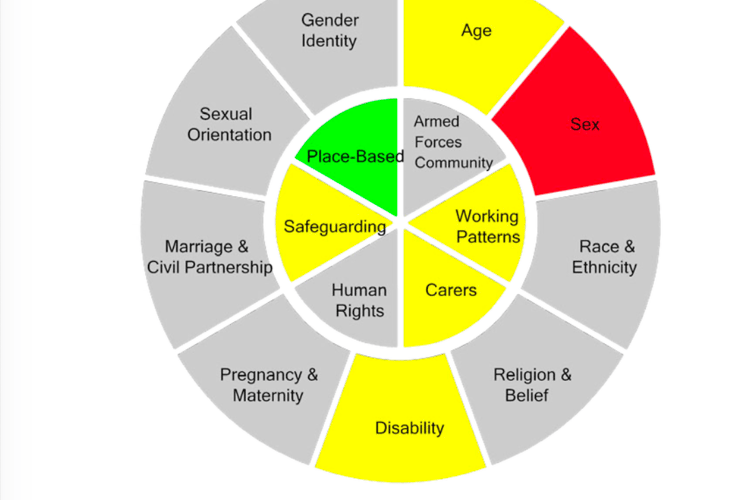
The second criteria that the council’s analysis covers is the impact that the switching off of street lights will have on equality and inclusion.
In this, the council identified multiple areas where it will have either a short term or long lasting negative impact.
It noted that it would have a disproportionate impact on women and girls, mostly owing to the fact they’ll perceive it as being unsafe. It stated: “There is a risk that women who have to rely on walking to get to work, during the night or early morning (example: shift workers, those who work in the night-time economy), could feel vulnerable with the lack of streetlighting.”
It also identified the mitigations which would take place, adding: “The lighting being kept on in Town centres will offer significant mitigation to this risk.
“Concern has been raised by Safer Towns groups regarding the safety of women and girls if lighting is switched off. As a direct result of these discussions the lighting will remain on until 3 am on Saturday and Sunday mornings in towns and cities where nightlife is more prominent.
“We are working closely with the police using their crime data to ensure we do not add inherent risk to known crime areas where it is deemed switching lights off will cause further crime. This is particularly the case where there is known domestic abuse.”
The council also identified potential risks for older members of the community, those who work night time work patterns, carers, safeguarding and the disabled, deeming these to have an impact of ‘short term or limited negative impact’.
As for the places which would see the changes, it added: “Lights will be switched off between midnight and 5am outside of town centre areas across the whole of Cornwall. Town centres will remain switched-on all night.
“Residential areas within towns that will have lights on until 3am on a Saturday and Sunday morning include Penzance, St Ives, Hayle, Helston, Falmouth, Camborne, Redruth, Truro, St Austell, Newquay, Bodmin, Liskeard, Saltash, Torpoint, Launceston, Bude.
“Many parishes and rural residents have already been in contact to request lights be switched off. Where concerns are raised, these will be considered. Any deviations from the policy should be approved by the portfolio holder for transport.”
Comments
We've recently changed our login process. If you have an account for commenting, you will need to re-register on the login window.
This article has no comments yet. Be the first to leave a comment.