
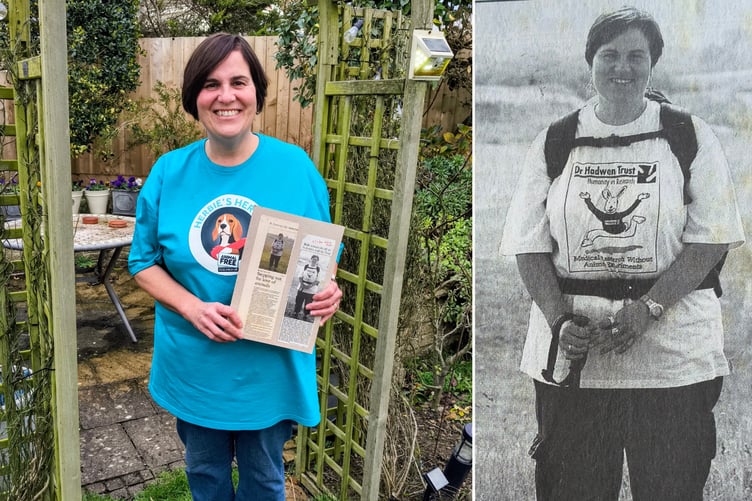
A WOMAN from Bude is marking 20 years of fundraising by walking 100km within five days.
In 2006, Steph Jones-Giles set herself the challenge of walking from Penzance to Falmouth to raise money for Animal Free Research UK. Ten years on, she took on a ‘sponsored slim’, once again raising money for the charity.
2026 marks 20 years since Steph first took on these challenges, and she’s celebrating by raising money for a cause close to her heart, but this time she’s tackling 20km every day for five days.
She said: “I am 20 years older with a heart condition which causes atrial fibrillation, and I take blood thinners. I decided that walking from my home would allow me to undertake the same distance in the same timeframe but with some sensible flexibility in the day.”



For this challenge Steph has chosen a personal cause, a research project exploring the connection between dementia and abnormal heart rhythm, undertaken by Dr Adjanie Patabendige at the University of Derby.
In 2016, Steph raised money for heart disease in memory of her father and in 2024, her brother sadly passed away with heart disease, both of whom experienced atrial fibrillation.
Commenting on her research, Dr Patabendige said: “Atrial fibrillation is the most common cardiac rhythm disorder, which causes irregular and often rapid heartbeat. In people aged over 55 years, atrial fibrillation is projected to double over the next two decades due to an ageing population. Atrial fibrillation also affects the blood supply to the brain. This increases the risk of developing stroke and dementia.
“My research expertise is on the “blood-brain barrier”, which protects the brain by forming a tight physiological barrier between the blood and the brain. Recent studies in atrial fibrillation patients with cognitive decline have found certain molecules that are not commonly found in blood. This indicates a disrupted blood-brain barrier. However, investigating these mechanisms in humans is very difficult. Therefore, there is a huge reliance on animals such as rats, mice, dogs and horses. To replace the use of animals, we are developing a fully humanised model of brain blood vessels using human brain cells and patient ECGs.
“This model can mimic abnormal blood flow in patients with atrial fibrillation, identical to blood being pumped by the heart. This allows us to study the effects of atrial fibrillation on the blood-brain barrier. In the longer term, this will ultimately provide targets to guide the development of treatments to protect the brain in atrial fibrillation and reduce the reliance on animal experiments in the future.
“Steph and the Bude supporter group have campaigned and raised vital funds to support research on animal replacement technologies for many years. I was truly moved to hear that Steph is planning to do a sponsored walk to raise awareness and funds to support our research on atrial fibrillation.”
Comments
This article has no comments yet. Be the first to leave a comment.