
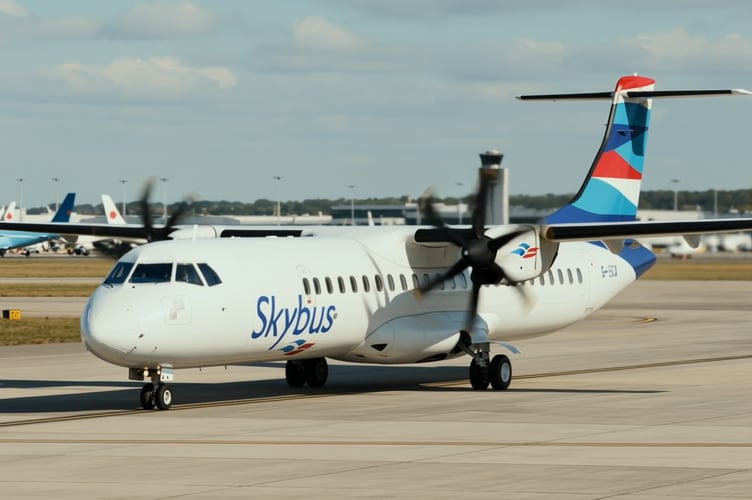
The managing director of Skybus has explained why the airline has been running flights from Cornwall to London that have been 80 per cent empty.
Jonathan Hinkles, who has 30 years experience in the airline industry including as chief executive of Loganair, lays a lot of the blame at the door of Eastern Airlines, which was operating the route before going bust in November.
“What was very clear was that Eastern Airways had done a huge amount of damage to customer confidence across Cornwall. I was flying regularly with them myself so I saw it first-hand.”
Mr Hinkles says Skybus – which took over the Public Service Obligation (PSO) contract by Cornwall Council to operate the London route in November – has a “hill to climb” to repair the previous airline’s damage and improve customer confidence.


.jpg?width=209&height=140&crop=209:145,smart&quality=75)
The PSO route is funded by the Department of Transport (DfT) and Cornwall Council via Cornish taxpayers.
Mr Hinkles spoke to us the day after it was revealed at a Cornwall Council meeting that since Skybus, which is part of the Isles of Scilly Steamship Group, took over the service on November 23 it has operated with 80% empty seats.
Mr Hinkles explained that was largely down to a last-minute decision to use larger aircraft in order to keep the threatened air link going.
He said: “We were planning to fly a 70-seat ATR aeroplane on the route and then, literally, a few days before we were due to start flying, the airline that was providing us with that aircraft ceased trading as well.
“We could either delay the start of the service, which was going to further set back the rebuilding effort we know we have to do on customer confidence, or do we get the route started with a larger aircraft because that is all that is available?
“So we’ve been flying the route with predominantly of late a 97-seat aeroplane, but certainly within the first month of operating we were using aircraft that were two-and-a-half times the size of the aircraft there.”
Mr Hinkles added: “When you’re looking at the percentage of seats filled, yes, it’s extremely low because we’ve got far more seats than we thought we had. It’s not a question of having far fewer passengers.
“We could have potentially killed off the thing once and for all by putting back the start date. That was the decision we had to make.”
The PSO subsidy paid to Eastern Airways was around the £1m mark. We understand the figure paid to Skybus is around £1.9m, made up of the DfT and Cornwall Council contributions.
“The subsidy level that Eastern was flying for was very low,” Skybus’ MD told us. “That then became its own problem. They were losing money flying the route. That’s why they were then taking aircraft away to fly Bristol Rovers and Plymouth Argyle to earn some more money.
“You’d be waiting for the PSO air service in Newquay on a Thursday night thinking ‘where’s the aeroplane?’ and you’d look at Flightradar24 and you’d see it was moving a football team from one side of the country to the other because they were making far more money doing that than they were from the PSO.
“It became a vicious circle that the previous PSO subsidy was very low. I was at Logainair at the time and thought when I saw it that they’d underpriced it and wondered how they could afford to do it for that. The reality was they couldn’t and they left an almighty mess.”
He says the subsidy level has now gone up but it is more in line with other PSO air services to London from the likes of Dundee and Derry.
“The subsidy per passenger long term will be about half that currently funded to the Dundee to London service. I think it’s almost identical to that on the City of Derry to London service.
“The DfT fund half of that and one of the things they look at is the subsidy per passenger, and the Newquay service comes out better than some and about the same as probably the best one, which is Derry.”
Does that mean that Cornish passengers are paying over the odds to fly to London?
“No, we’re charging less than Eastern were. Eastern’s average fair was about £115 one way, we’re at about £100. It’s about maintaining essential connectivity and balancing the subsidy that is required to support that connectivity against keeping fares at a level that people will pay.
“If there was no subsidy, the service frankly wouldn’t be there and Newquay wouldn’t have the frequency of flights it has up to London.”
Mr Hinkles added that the frequency of flights is about to increase and bookings are already improving.
“We go to two flights a day from weekdays from the middle of February. You can already see in the forward bookings that the bookings step up.
“Passengers typically book between three and eight weeks ahead of travel so until you get into that cycle with a new service, it takes a bit of time to build.”
He added: “We’ve got a hill to climb. I’d probably call it a hill rather than a mountain to be honest. We’ve got a hill to climb because of the damage and the customer confidence hit that this has taken with Eastern. We’ve got to get past both of those things.
“When you restart a route that has been subject to the interruption it has it’s going to take short period of time – a period of time nonetheless – to build it back.”
When the twice daily flights start is he expecting to see the maximum seat take-up?
“No PSO air service tends to run completely full 100% day in day out. During the height of the summer when more people are travelling the subsidy comes down, but during the winter when you want the connectivity for the region but the passenger numbers drop the subsidy goes up.
“It’s worth pointing out that roughly half the subsidy – Cornwall Council’s contribution pretty much – goes straight back to Newquay airport in the landing fees and everything else. So if we weren’t there Cornwall Council would be giving it straight to Newquay airport anyway and the shareholder would have to cover the losses.
“It’s a bit of an argument of saying you’ll have to put that money into the airport anyway so if you can get the economic benefit of having good connectivity to London it squares the circle.
“I’m one of those people who wouldn’t be able to have my job in Cornwall if we didn’t have that connectivity. I see other people on the same flights as me working in property or very specialist roles in the marine sector and they’re all saying ‘thank God you’re here’.
“In the few weeks the service wasn’t there and they were doing the journeys by sleeper or whatever else, it just didn’t work for them.”
Mr Hinkles pointed out that the high cost of landing at London airports also plays a part in PSO subsidy.
“The main reason DfT provides that support for air services for Newquay, for City of Derry, for Dundee into London is actually because the costs of operating in and out of whichever airport you choose in London are very high.
“Gatwick airport in broad terms charges you the same landing fee for an ATR aircraft coming in from Newquay as it charges Emirates to land an Airbus A380 from Dubai. Those charges, particularly during the summer when they ramp up the landing fees at Gatwick, are very, very high. It’s the same at Heathrow.
“So of the funding that comes in, the vast bulk of what Cornwall Council puts in goes straight back out of the airline’s door back to Newquay airport and the vast bulk of what DfT contributes is to help cover London airport costs.”
Mr Hinkles says he feel positive about the future. “We’ve just had our strongest week of forward bookings since the service was relaunched by Skybus in the last week. The booking levels have been incredibly positive.”
Comments
We've recently changed our login process. If you have an account for commenting, you will need to re-register on the login window.
This article has no comments yet. Be the first to leave a comment.