
EACH week, hundreds of planning applications come before Cornwall Council’s planning department, seeking to win approval for various plans right across the Duchy, with some concerning Holsworthy handled by Torridge District Council.
These plans can comprise of a number of different reasonings– ranging from permission to replace windows or listed building consent ranging up to large house building developments or changing of use of a building, for instance, from an office to a café, or flats.
Within this large and often complex system, there are a number of formats from which planning advice and approval can be sought.
These range from full applications where all the details which comprise a proposed development or work to a building are submitted, to outline applications, where further details are yet to be confirmed, for example, an outline application with reserved matters for appearance may not confirm the final proposed development but rather seek permission in principle.



An example of this is one for an outline permission for 20 dwellings on land with reserved matters for appearance and scale; the reserved matters would require further permission later for their inclusion.
Other types of applications include pre-application advice requests, where would-be developers submit often outline proposals to a local authority to ascertain whether it is likely to gain support or not prior to submitting a planning application.
The vast majority of applications are decided by planning officers employed by a local authority under ‘delegated powers’, meaning they do so on behalf of their employer, however, some applications are ‘called in’ by local councillors to be discussed at an area’s strategic planning committee meeting, meaning the final decision rests with a committee of councillors.
‘Touristic’ accommodation refusal
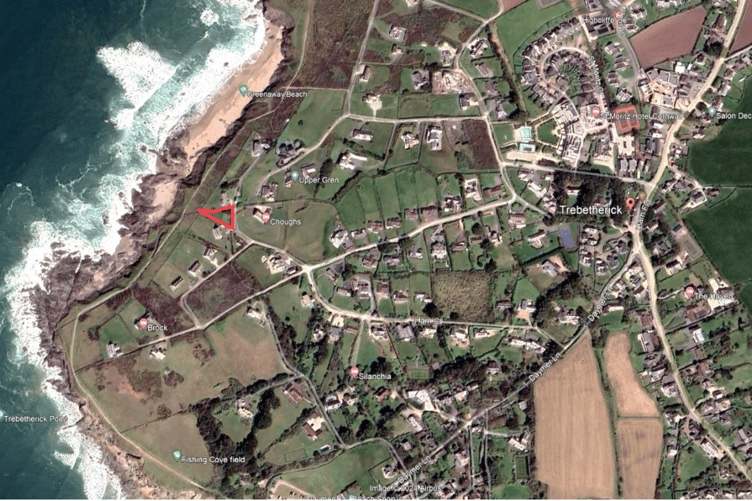
AN application seeking to build ‘touristic accommodation’ at Trebetherick, near Polzeath has been refused.
The application sought full planning permission for the erection of new touristic accommodation on a small pocket of undeveloped land, measuring approximately 0.1 hectares, at Trebetherick.
However, it was met with vociferous objections from residents and the parish council.
Cornwall Council refused the application stating the addition of a new business in the tourism sector would further distort an ‘already exceptionally imbalanced local housing market’. It also said it would ‘result in a visual extension of the built environment and urbanisation of the site that would unavoidably erode its current natural character’.
It stated: “The proposal would represent the provision of unsustainable touristic accommodation in the countryside, outside the limits of the settlement of Trebetherick, and result in a visual extension of built environment and urbanisation of the site, harmfully eroding its current natural character and diminishing the spatial relationship and pattern of development which are integral to the character and appearance of the surrounding area.
“In its failure to respond to its landscape and seascape setting, the development proposal would adversely alter the character of the site and the scenic qualities of the surrounding area and thus, together with the further distortion to the exceptionally imbalanced local housing market, would not provide a well balanced mix of economic, social and environmental benefits.
“In the absence of any special circumstances to justify touristic development in this location, whilst the proposed unit of accommodation would generate some limited benefits during the construction stage and subsequent operational phase, it does not amount to sustainable development.”
Plans for new holiday units
CORNWALL Council has been asked to give its views on potential proposals for the provision of five new holiday units at a location at St Clether.
The proposals at Ta Mill Road, St Clether, Launceston would also include upgrades to the site including the renovation of a barn, a swimming pool building, the replacement of three holiday log cabins with three new holiday units, the renovation or replacement of four holiday cabins with four new cabins, alterations to a building to form a bar and the addition of a first floor to provide a function room and sensitive work to a listed house.
A pre-application advice enquiry seeks Cornwall Council’s views on a proposal with the aim of identifying whether it is likely to gain officer support – and what would be required to potentially obtain it if not.
It could later potentially form the basis of a full planning application.
The applicant’s planning agent told Cornwall Council: “The current layout of the former farmstead has evolved from that shown on the historic maps. This is mainly by the provision of more modern agricultural structures above (north of the core group) with a new access track running east to west linking other farm buildings. Equally, holiday lodges approved from the 1970’s run east to west (east of the farmhouse).
“The overall arrangement is more linear running east to west across the site. This evolving pattern of development utilises the topography of the site which slopes down to the south and avoids further encroaching onto the wider landscape beyond the core area of the site. Consolidating guest accommodation close to the central courtyard also improves the functional operation of the site. The proposed siting of new and replacement holiday units and visitor facilities barn follows the established pattern of development on the site whilst continuing to respect the historic core layout depicted on historic mapping.
“Importantly, the arrangement retains visual permeability through the site, allowing the historic farmhouse and courtyard group to remain readily legible and appreciated within their setting. The new buildings are not proposed as a competing focal point to the historic farmstead; rather, they are deliberately positioned and designed to sit as a subservient contemporary layer within the site’s ongoing evolution.
“The historic farmstead has never been a static environment and has adapted over centuries to changing agricultural and tourism-related requirements. In this context, the proposed development should be understood as the next stage in that evolution, providing modern accommodation and facilities necessary to secure the long-term viability and sustainability of the tourism enterprise whilst respecting the significance of the heritage asset.
“The proposals therefore represent a continuation of the site’s established pattern of adaptation rather than the introduction of an incongruous or competing form of development. Retention of the existing orchard planting (north of the farmhouse), together with new native species planting and Cornish hedge banks, will enable the new buildings to sit comfortably within the landscape without causing harm to the legibility of the site.
“A clear spatial separation is maintained between the historic courtyard and the new cluster, preserving a discernible break of open ground and landscaping. By stepping the new structures into the slope, they remain low in height and allow views across and through the development, reinforcing the visual dominance and appreciation of the historic core.
“Existing and proposed planting further softens their presence, substantially reducing any perceived encroachment into the rural backdrop of the farmhouse.
“Equally, the works to increase the height of the recreation room and pub, allow these structures to be brought into more viable uses which support the function/operation of the tourism business. These works maintain the original plan form of courtyard arrangement as existing. The use of sympathetic materials and finishes ensures they are sympathetic to the legibility and setting of the Grade II Listed farmhouse.”
Find out about planning applications that affect you by visiting the Public Notice Portal.
The documents can be found on the Cornwall Council planning portal using reference PA26/00701/PREAPP.
Comments
This article has no comments yet. Be the first to leave a comment.