
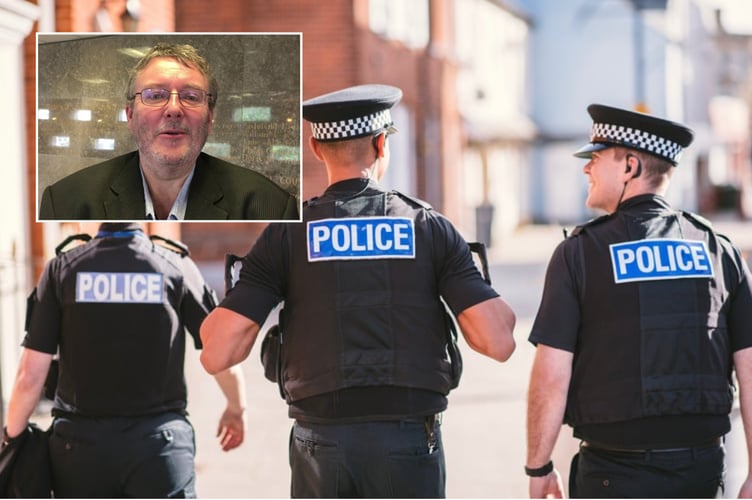
Cornwall is being “shafted” by Devon and Cornwall Police. That was the view of a committee chairman at a Cornwall Council meeting last week.
Cllr Andrew Mitchell, who chairs the council’s community wellbeing scrutiny committee, made his feelings known in light of another councillor’s comments about a lack of policing in West Cornwall.
The committee was discussing an agenda item about the Safer Cornwall Partnership, which is made up of Cornwall Council, Devon and Cornwall Police, Cornwall Fire and Rescue Service, National Probation Service and NHS Kernow.
The partnership has a responsibility to work together to do all it can to reduce crime and disorder, anti-social behaviour, problem use of drugs and alcohol and re-offending.



Independent councillor Brian Clemens raised concerns about whether Devon and Cornwall Police can deliver Safer Cornwall’s aspirations “bearing in mind the shortages we’re experiencing, especially in West Cornwall”.
The councillor for Land’s End added: “Hopefully in the near future when we get the policing numbers back up to where they should be, town and parish councils won’t be having to pay for so many stewards on the streets. There is a considerable amount of taxpayers’ money being used to do what the police should be doing.”
Cllr Mitchell, an Independent who represents St Ives West and Towednack, responded: “In no way am I having a go at policing staff, I think they all do a brilliant job, but parish councils are having to put marshals on to replace what the police should be doing.
“I know every police officer is dedicated and they do an amazing job, but there just isn’t enough and Cornwall is being – I’m going to use the word – shafted by Devon and Cornwall Constabulary.
“I was absolutely horrified to see the policing levels that the commander recently gave at a meeting in West Cornwall. The precept from St Ives is well over £1.5-million and we get 1.5 police officers for that.
“We’re certainly not getting value for money. I know Devon will probably argue the same, particularly rural communities.”
He added: “I think we do need to be stronger in explaining to the police that we think Cornwall is being ignored and we’re hard done by. We’re paying for police that are not there.
“I want to get the police here and say that on behalf of communities that we represent they have to do better.
“I’m sure it’s a national picture that the police numbers are way too low after the cuts of previous governments, but I don’t see us getting a fair bang for our buck and I think we should be writing to explain very loudly and very clearly to the police force that we don’t think what’s going on is fair and we need the policing that we deserve and that we pay for.”
Safer Cornwall chair Simon Mould replied to the councillors’ concerns: “I very much hear and understand the point that you have made. I give you my reassurance that I most definitely have been raising our concerns from a partnership perspective with the commander and I’ve also met him with the portfolio holder [for community safety, Cllr Thalia Marrington] where we have put that position forward.”
The police commander for Cornwall and the Isles of Scilly is chief superintendent Scott Bradley, who took over leadership in late 2025.
Mr Mould suggested that the scrutiny committee puts its policing resource allocation concerns to the Devon and Cornwall Police and Crime Panel, which is the appropriate governing body that holds policing to account.
The comments came after criticism about a lack of policing in St Ives by the town council last September.
St Ives’ then deputy mayor Cllr Ken Messenger – who died on Christmas Eve – claimed that the area has suffered from a lack of policing and, consequently, there is low public confidence in the police and under-reporting of crime.
On his recommendation, St Ives Town Council members passed a no confidence vote not just in the Devon and Cornwall police and crime commissioner (PCC) role but in its holder Alison Hernandez herself.
The council agreed to write to the deputy prime minister, the home secretary and Cornwall Council, copying in the PCC and the chief constable, calling for “a more broadly representative form of governance and oversight reflective of Cornwall’s status as a nation, which ensures better local accountability, effectiveness and value for money for our area and will help restore public confidence in our police force”.
It has since been announced by the government that the PCC roles will be abolished in May 2028, at the end of their current term.
We have contacted Devon and Cornwall Police and the PCC office for reaction to Cllr Mitchell’s comments.
Chief superintendent Scott Bradley, commander for Cornwall and the Isles of Scilly, said: “Local policing in Devon and Cornwall Police is delivered through a number of teams including patrol, neighbourhood policing, crime management investigation teams and domestic abuse investigation teams. We always seek to achieve the right level of staffing to deliver our policing services effectively and efficiently and to keep the public safe.
“West Cornwall, which includes the towns of Penzance and St Ives, are serviced by a number of police teams including those listed above. We also draw on other force assets including, but not limited to, the neighbourhood support team, criminal investigation department, force support group and roads policing team.
“Our policing model is flexible, providing a 24/7 response function, a visible presence across communities, investigating all types of crime and being able to mobilise resources across the force area to meet demands.
“The force is also working to increase the number of frontline operational resources in all areas of the force, including West Cornwall.
“Our policing teams remain committed to keeping people safe, deterring criminals and bringing offenders to justice and they will continue to do so.”
Comments
We've recently changed our login process. If you have an account for commenting, you will need to re-register on the login window.
This article has no comments yet. Be the first to leave a comment.