
HEADLINES were made last week when a Helston supermarket’s bilingual signs were exposed as not exactly Cornish, and more – well, Welsh.
Shoppers were buying pysgod/fish and byd môr/seafood, when they should have been enjoying the experience of browsing “pysk” and “boos mor”. (I was going to use “carrots” as an example, but have just learned the Welsh for this is “moron”, which isn’t really the look I was aiming for).
Given that Wales is a good four hours up the A30 and M5, and Cornwall has a perfectly good language of its own – Kernewek – this discovery was surprising to say the least, and left Tesco with no small amount of oy/egg on its face.
Perhaps this is why the supermarket’s statement was curt and to the point: “We’re sorry for this mistake and have removed these signs.” No explanation was provided as to why they had appeared in the first place, or whether they would be replaced by bona fide Cornish versions (mar pleg/please?)


-Rebecca-Marks-and-Ross-Hancock-showcase-the-Cornish-Pirates-departure-lounge-takeover.jpeg?width=209&height=140&crop=209:145,smart&quality=75)
To be fair, the reception was mildly amused on home turf, with Cornish speakers quick to commend Tesco’s willingness to accommodate bilingual signage. Dr Garry Tregidga, co-director of the University of Exeter’s Institute for Cornish Studies, said: “This is obviously embarrassing for Tesco, but it is great if there was the intention to have signs in Cornish. I hope there will be replacement signs put up in the right language.”
He added: “What is also positive is that this mistake was spotted. This is a sign of the increasing number of people who are using and recognising Cornish. If anyone from Tesco needs assistance putting together the new signs, there are plenty of people who would be glad to help.”
In November, the government elevated the Cornish language to the same level as Welsh and Gaelic, while the Institute’s Cornish Democracy Unit emphasised in discussions at local and national level the need for a specific political settlement for Cornwall as opposed to an “artificial solution” of 'Devonwall' (perish the thought).
“The government now recognises the Cornish language at the same level as that of Welsh and Gaelic, and this provides a real opportunity to bring together the cultural, economic and political dimensions of Cornish identity,” Dr Tregidga continued. “It helps communities work towards a brighter future, rather than allowing us to remain an impoverished region on the edge of the UK.”
Bilingual signage is enjoying a moment. This side of the pond at least, MAGA is Cornish for "grow, nurture or develop", and ever since its formation in 2009, Cornwall Council has been committed to increasing the number of signs bearing Cornish translations provided by the Cornish Language Office. A major milestone was reached in 2014 with the installation of the 1,000th bilingual street sign, and as of November 2022, there were more than 3,000 in place across Cornwall.
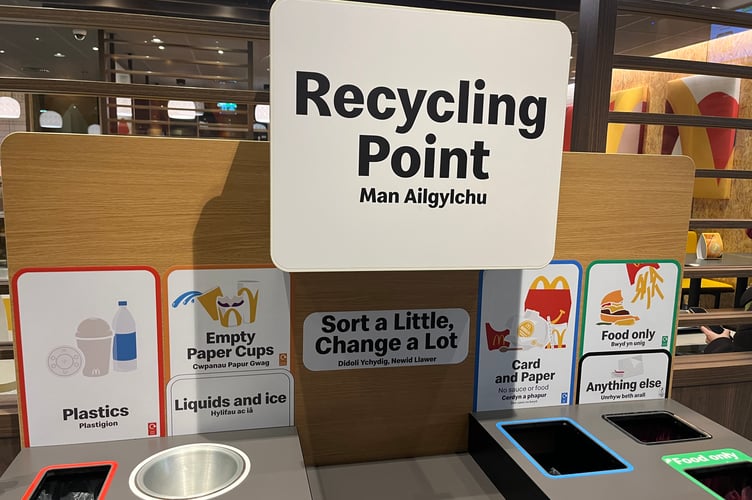
Everything in its right place, however. Over New Year, while en route to visit family members on northern shores, we stopped at services on the M18 and were surprised to see prominent notices in Welsh in McDonald’s. There was nothing intrinsically wrong in this, but they did feel somewhat out of context: “This is Doncaster, not Dolgellau,” said The Other Half (who, for the record, went to university in west Wales).
As a former languages student, I’m all for acknowledging that English is not the only communication medium in the world. While it might be convenient to use it as a lingua franca, there are so many tongues out there with equally important heritage that are deserving of increased status.
So come on, Tesco: let’s see signs in actual Kernewek west of the Tamar (possibly even beyond, albeit maybe not as far as Doncaster). If you get your roskisyow/skates on, you might even have them in before St Piran’s Day on March 5. Just a thought. Meur ras a-dherag/thanks in advance.
* “I READ your column,” said my mother-in-law over Sunday lunch. “Which one?” I asked, scanning my back catalogue to work out which one might have caused the raised eyebrows currently before me. “The one about changing my kitchen lightbulb,” she replied, frostily.
Apparently, revealing a lack of cleanliness in the illumination department – specifically, the line about how the fluorescent tube was “covered in at least a decade’s worth of cooking grease, and all the dead insects trapped therein” - was a faux pas in need of rectification.
I hereby declare, in the interests of familial harmony, that I’m sure MIL’s lightbulb was no dirtier than any other in the land; and, furthermore, that anyone who has the time or inclination to clean their lightbulbs is clearly in need of some greater purpose in life.
I still wouldn’t have put that lightbulb in my handbag, though. Just sayin’.
Comments
We've recently changed our login process. If you have an account for commenting, you will need to re-register on the login window.
This article has no comments yet. Be the first to leave a comment.