
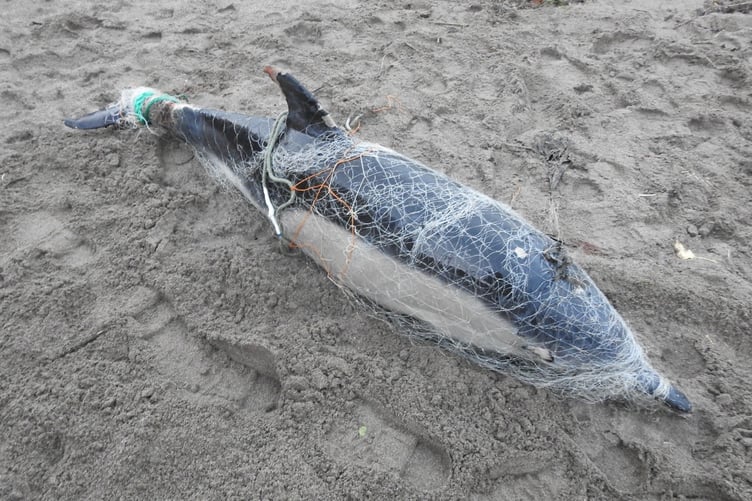
FISHING nets have been deemed the most common cause of death among common dolphins that become stranded on Cornwall’s coast according to new research.
The study was carried out by a partnership including Cornwall Marine Pathology Team (CMPT), Cornwall Wildlife Trust and the University of Exeter, operating under the Defra-funded Cetacean Strandings Investigation Programme.
It found that more than 860 short-beaked common dolphins were found stranded around Cornwall from 2018 to 2024. However, the vast majority were dead — with 175 dolphins were recovered by volunteers and given a post-mortem examination (called a necropsy).
The most common cause of death was “bycatch” – death following entanglement in fishing gear – which killed 39 per cent of the dolphins.
Infectious disease (25 per cent), live stranding of healthy animals (10 per cent), non-bycatch trauma (eight per cent) and starvation (seven per cent) were the other leading causes of death.
Rebecca Allen of the Cornwall Wildlife Trust, which plays a key role in monitoring strandings around Cornwall’s coast and retrieving animals for necropsy, said: “This vitally important research highlights the amazing efforts of James Barnett and the CMPT team, and the passionate determination of the hundreds of our Marine Strandings Network volunteers who go out in all weathers to document these animals and ensure their deaths do not go unnoticed and unremembered.
"It also shows that whilst many of our local fishermen are doing what they can, bycatch remains a significant issue in the Southwest. We need urgent, high-level action to achieve better management of the static net fishery and to support local fishers' access to appropriate bycatch mitigation technology.
"Reducing bycatch is a win-win for both fishers and wildlife; reducing interactions with fishing gear both prevents unnecessary deaths of ocean wildlife and helps protects fishers’ nets and catch.”
Of the 43 cases in which infectious disease was the probable cause of death, 32 dolphins had been severely affected by parasites.
Starvation was mostly found in young animals, around the age of independence from their mothers – suggesting these individuals failed to make the transition to self-feeding after mothers stopped nursing, or were prematurely separated from their mothers.




Of the 14 cases of non-bycatch related trauma, two animals had lesions consistent with attacks by bottlenose dolphins. One of these – an adult male weighing 107kg – is one of the largest animals known to have been killed by bottlenose dolphins in the UK.
Two dolphins had lesions consistent with ship strike, including one juvenile male with wounds consistent with propellor injuries.
Two animals choked to death on flatfish. The heads of the fish were lodged within the bony nasal passage of the dolphins.
The short-beaked common dolphin is the most frequently stranded cetacean species (whales, dolphins and porpoises) in Cornwall, with over 100 strandings each year.
The new study suggests Cornwall is “the hotspot for bycatch of this species in the UK” – possibly due to the large number of common dolphins frequenting the waters around Cornwall and the number of fishing vessels in Cornish waters.
The study was funded by the UK government’s Department for Environment Food and Rural Affairs.
Comments
This article has no comments yet. Be the first to leave a comment.