
.jpeg?width=455)
THE revelations of the contents in the Epstein files, featuring documents and material relating to the disgraced financier and pedophile Jeffrey Epstein has led to a reaction of concern from the Duke of Cornwall.
A spokesperson for Prince William and Princess Catherine, the Duke and Duchess of Cornwall said: "I can confirm The Prince and Princess have been deeply concerned by the continuing revelations.
"Their thoughts remain focused on the victims."
While Cornwall did not feature extensively in the files, references to the Duchy revealed that Epstein held an interest in the tax affairs of King Charles III during his time as the Duke of Cornwall, seen in a conversation with an aide of Andrew Mountbatten-Windsor, formerly Prince Andrew, in addition to more obscure interests.



King Charles’ tax
The tax affairs of King Charles III when he was the Duke of Cornwall was of a keen interest to Mr Epstein.
It began with an initial email from the disgraced financier to a David Stern, understood to be a close aide of Andrew Mountbatten-Windsor, formerly Prince Andrew, where Mr Epstein wrote: “Not sure yet, but got a call re I rumor (sic) of inquiry (sic) in PA Taxes?” on Saturday, July 20, 2013.
PA is understood to refer to ‘Prince Andrew’.
This was followed by correspondence between the two with the following emails, with the files not making clear who sent what to who.
“When can I call you?” followed by “cell”.
This was followed by an email from ‘DS’, understood to be David Stern, to Mr Epstein in the evening of Saturday, July 20, where ‘DS’ sent the content of a breaking news story relating to the tax affairs of King Charles when he was the Duke of Cornwall.
The BBC news story related to comments made by William Nye, an aide to the then-Prince Charles who told the Public Accounts Committee of MPs that Charles was not liable to pay corporation or capital gains tax on his income as the Duke of Cornwall.
Mr Nye said that the Duchy of Cornwall was not a corporation but rather a private income, adding that Charles voluntarily paid income tax on the money received from the Duchy.
The article focused on criticism of the arrangements by members of the committee relating to the tax affairs of the Duchy, which at the time was worth £762-million.
During that year, the Duchy paid the then-Prince Charles £19-million, of which £4-million was paid to the treasury in income tax and VAT receipts.
The chair of the committee at the time, Dame Margaret Hodge, questioned the ‘fairness’ of the tax arrangements.
This was met with a response from Mr Nye who said that the Duke of Cornwall doesn’t pay capital gains because he doesn’t have access to them, adding that any gains are reinvested in the Duchy for future dukes, adding that if the system was changed by legislation, it would cost taxpayers more to pay for the Duke’s official duties and he would be free to spend the money earned from the Duchy on ‘other things’.
The appearance before the committee came later in a month that saw Andrew George, the member of parliament for the St Ives constituency (then known as West Cornwall) who called on the Duchy to ‘come clean’ about the Duke’s tax arrangements.
The architecture of St Mary Magdalene
Perhaps one of the most obscure and least dramatic in a large swathe of documents that has caused seismic ruptures in the world’s political circles while putting a sun-bright spotlight on the sordid life of some of the moneyed and elite, is the architecture of a church in Launceston referenced in the Epstein Files.
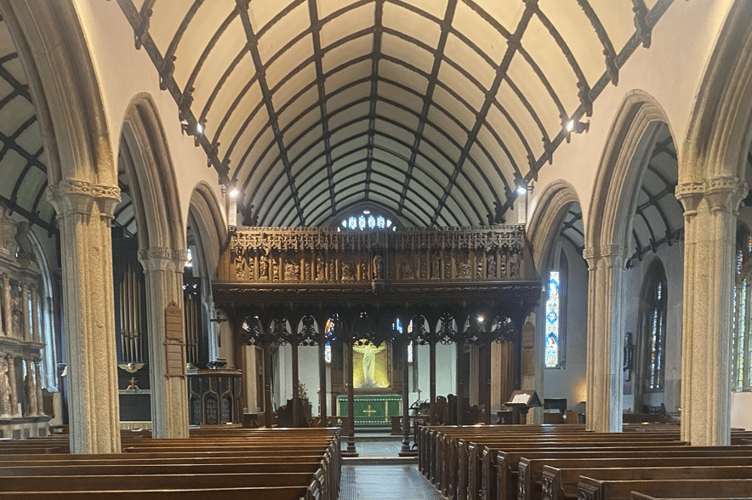
In the files is what appears to be an article or a newsletter from a publication called ‘the Weekly Standard’, a neoconservative magazine published in the United States.
Operational between 1995 and 2018, the Weekly Standard was often described as the ‘neocon bible’ and the ‘redoubt of neoconservatism’.
The article in question was published on February 2, 2009 and concerned ‘The Gothic Vision – Blueprints for technology in patterns of design’ and featured an analysis of gothic architecture and how it relates to computer science – specifically the resemblance of ‘recursive structures’.
In a section which discussed various gothic architectures across the world, the example in Launceston was featured where it stated: “Recursion is especially important to English tracery of the Perpendicular period. The Perpendicular style, which emerged at London and Gloucester in the 1330s, is "late Gothic" and unique to England—a style that combines dazzling virtuosity (on occasion) with a certain decorum and prickly restraint.
“The relation between recursion and Perpendicular design is a story in itself, but a window from the church of St Mary Magdalene in Launceston, Cornwall, is a simple example. It is an arch with an elongated diamond in the centre flanked by two other diamonds. Superimposed is a Y-shaped mullion that creates two smaller arches—each with an elongated diamond on top, flanked by two others.”
Ebola in Cornwall
As well as his more notorious behavioural and financial interests, the Epstein Files gives an indication of the sort of things that Mr Epstein liked to read about.
Multiple examples of emails in the files feature news summaries and digests sent directly to Mr Epstein.
In one of them, the outbreak of Ebola in 2014 was referenced, specifically a City AM article about a patient in the Royal Cornwall Hospital in Truro being tested for the disease.
There were several stories within the digest related to the potential spread of Ebola in the United Kingdom.
In December 2014, a patient at the Royal Cornwall Hospital in Truro was isolated and tested for Ebola after returning from West Africa. Public Health England confirmed the patient was considered low-risk, and tests subsequently came back negative, with the patient given the all-clear.
The individual was admitted to an isolation unit in Truro on December 30, 2014, following precautionary measures due to recent travel to a country affected by the virus.
Comments
This article has no comments yet. Be the first to leave a comment.