
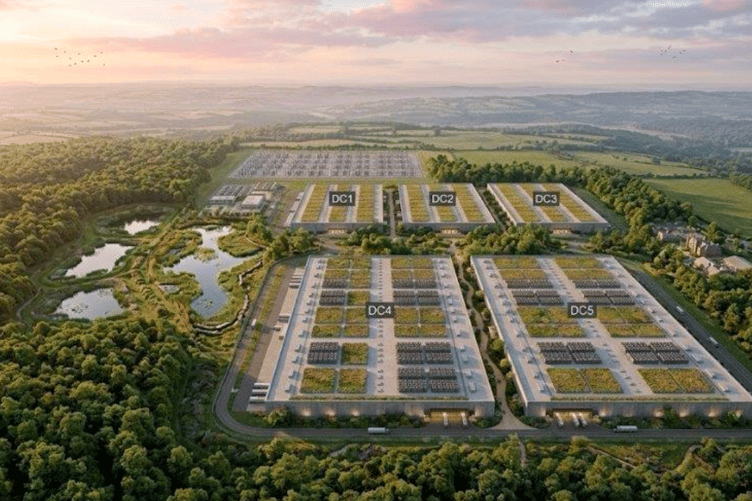
A FREEDOM of information request by campaigners seeking to protect Devon’s countryside has revealed a plan that could see North Devon turned into an area where AI investment is encouraged.
The documents also show that Torridge District Council is being pressed to designate the proposed Great Torrington data centre site as suitable for development in their emerging Local Plan.
Correspondence requested by the local activists shows that Xlinks, the developer proposing the 1.8GW data centre and battery system close to Torrington, has applied to the government for AI Growth Zone designation, which would bring advantageous conditions for their project and also encourage more data centres to co-locate in the area.
In a briefing document that was disclosed as part of the freedom of information request, XLinks described the scheme, known as ‘Valeon’ as a ‘state of the art data centre’ which will have between two to five gigawatts of AI-optimised computing capacity.
It claims that the scheme will set a ‘new green global standard’ which will provide a net positive to biodiversity and with ‘world leading low levels’ of water and energy use alongside large new public open spaces and new woodland areas.
The scheme’s promoter’s claims also state that it’ll lead to £12-billion to £14-billion of investment and thousands of jobs to ‘one of the UK’s most deprived areas’.
XLinks is also promising to consult closely with the local community and has a ‘track record of amending scheme plans to address local concerns’.
It further states that Torridge District Council is supportive of the scheme and the reason it seeks to come to the area is due to its advantageous climactic conditions, with good connectivity and a generation heavy local grid infrastructure.
“Not only does the developer admit that they are looking for this designation for up to 5GW of data centres – two and a half times the size of their own gigantic project – but we now find that the local authority is considering writing the Torrington site into their Local Plan as suitable for industrial development,” said Ken White, of the Devon Data Centre and BESS Action Group, which is working in tandem with Devon CPRE to oppose the plans. He added, “This would be a catastrophe for the area, turning hundreds or even thousands of acres of the beautiful Devon landscape into a giant, noisy industrial estate.”
Devon CPRE chairman Steve Crowther said: “Making part of Northern Devon an AI Growth Zone would be a monumental decision. We already know that such a development would be highly likely to be incompatible with our status as a UNESCO Biosphere Reserve. If North Devon and Torridge Councils are tempted to write this into their new Local Plan, it would make it virtually impossible for even the strongest public pressure to prevent the proliferation of huge data centres across the area.


“It would be unthinkable to adopt such a radical change to Devon’s planning environment – swapping UN-rated natural sustainability for AI-driven industrialization – without the consent of the people of North Devon and Torridge.”
Torridge District Council previously said: “We appreciate that this proposal will understandably continue to generate a lot of local interest. However, we are unable to comment any further as no formal proposals have been submitted.”
Inclusion in local plan ‘standard practice’
A spokesperson for XLinks said: “Xlinks sought pre-application planning advice from Torridge District Council (TDC), which is normal practice.
“We submitted an application for inclusion in the Local Plan, which is normal practice. There are no ongoing discussions between Xlinks and TDC in relation to the Local Plan.
“As is usual practice for UK AI data centre developments, an application was made to the UK government for AI Growth Zone.
“Xlinks data centre plans, which it intends to submit to TDC next year, are limited to 1.5GW of AI compute capacity.
“The proposed site is 850 acres, of which we plan to develop approximately a third. The majority of the land will be either open to the public or used for planting and to support wildlife by creating new habitats.
Subject to planning consents, the campus will be designed to support the local environment, while bringing economic growth and creating 650 – 1,200 permanent, high-quality jobs.
“We are carrying out nature and wildlife surveys on site. We must legally improve biodiversity by at least 10 per cent, and plan to exceed this by some margin.
“The data campus will be developed sustainably and will be designed to substantially increase biodiversity in line with the goals of the North Devon Biosphere. We will consult relevant stakeholders and follow their advice to ensure the project has a positive impact on local wildlife and nature.
“Buildings will be sited to minimise visibility, through topography, landscaping and the existing treeline.
“Comprehensive assessments - including on noise, air quality, water, flooding and fire safety are being carried out as part of our Environmental Impact Assessment, and any mitigation required will be built into the design and secured through planning conditions.
“There will be community benefit associated with the project worth tens of millions of pounds, to include skills development to best position local people for the high quality jobs the campus will provide.
“The Devon data campus will play a significant role in making sure the UK’s fast-growing ‘growing tech sector’ has the computing capacity it needs to drive economic growth.
“We'll continue to listen and respond to feedback as the project develops. Xlinks will hold a series of public information days at various locations near the site before submitting planning applications.
“Before we hold public events, we are offering elected representatives the opportunity to have initial meetings with the project team to ensure we are providing all the information the community needs.
“This is normal practice when consulting on a development of this type. The site is mainly made up of low to moderate quality agricultural land, most of which is used for grazing a small number of cattle and sheep. Some areas have slopes which significantly limit agricultural use.
“The project’s assessment of the land shows the development would result in negligible loss of nationally significant agricultural resource.
“The data centre will use air cooling and a closed-loop water system - it will not need to extract water from local rivers, streams or boreholes.
“Aside from domestic amenities like toilets and catering facilities, our plans are for the site to be self-sufficient in water.
Find out about planning applications that affect you by visiting the Public Notice Portal.
“Water used by the data centre or the battery facility will not be discharged to watercourses.”
Comments
We've recently changed our login process. If you have an account for commenting, you will need to re-register on the login window.
This article has no comments yet. Be the first to leave a comment.