
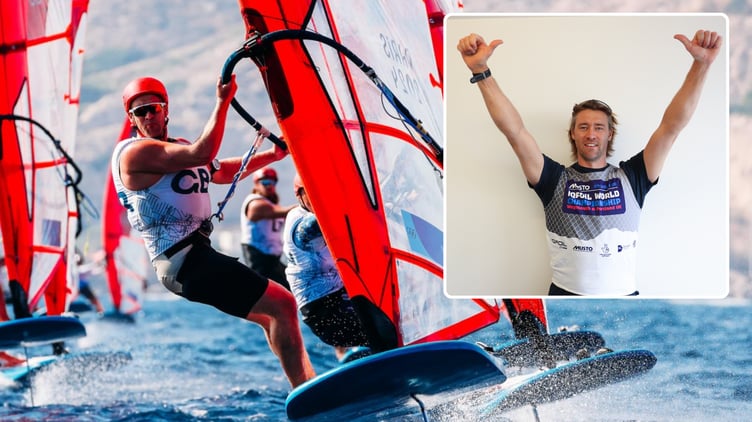
A CORNISH olympian is hoping to overcomes nerve damage and tackle the international stage for the windsurfing world championships.
British windsurfer Sam Sills, from Launceston, is set to take the waves in Weymouth and Portland for the Musto iQFOiL World Championships 2026, after recovering from a serious injury he sustained following his Olympic debut at Paris 2024.
An injury to the nerves which lead from his brain to the rest of his body ruled the Launceston-native out of competition for more than a year. He sustained the injury after someone landed on top of his head when jumping off a wall while Sam celebrated his team-mate Ellie Aldridge’s Paris gold.
Having been struggling to walk only a year ago, his return to the British Sailing Team means more than just racing.
“I’ve learned a lot about perseverance and resilience, more than I ever knew,” he said. “I thought I was quite resilient already and then this period made me realise what can be achieved if you just don’t give up and keep going.
“There’s a lot of moments in life when you need to do something or you have a big life challenge, seeing it happens in real time and having to overcome big problems. You’ve just got to keep going, chip away, and keep believing in what you’re doing.
“I was in pain every day and people say that these things make you stronger, but they don’t for a long time until you’re out of it. It was tough clawing my way back.
“There was a big question mark over whether I was going to be able to firstly, get back competing at a high level, and secondly, have a crack at the world title.
“Hopefully I can take that opportunity, and I really don’t know what to expect – that’s quite exciting. It’s been a crazy, long, difficult, horrendous journey but it’s been full of resistance.”
Ten athletes are part of the British Sailing Team fleet, with fellow Cornish sailor Max Beaman, from Falmouth, joining Sam in the selection.




Sam has said that he is looking forward to returning to competition in home waters and believes that the competition will be tough, as the world’s best reach speeds equivalent to 40 miles an hour.
“The conditions are pretty steady, and we get a lot of wind funnelling up through the channel,” he said.
“If we’re racing inside the harbour, it’s dead flat water, which makes it quite hard because the margins are small and it’s all about speed.
“The level is so equal across the fleet and it’s easy to fall behind from the top five to the top 30 competitors. If you show any sign of weakness, or if you make any mistakes, you get punished so hard.
“I tend to prefer those conditions because there’s more opportunities to win.”
“I haven’t dealt with really high pressure for a couple of years, so that’s been an experience to feel that again. You get so trained when you’re competing often and it’s a skill to deal with.”
Comments
We've recently changed our login process. If you have an account for commenting, you will need to re-register on the login window.
This article has no comments yet. Be the first to leave a comment.